
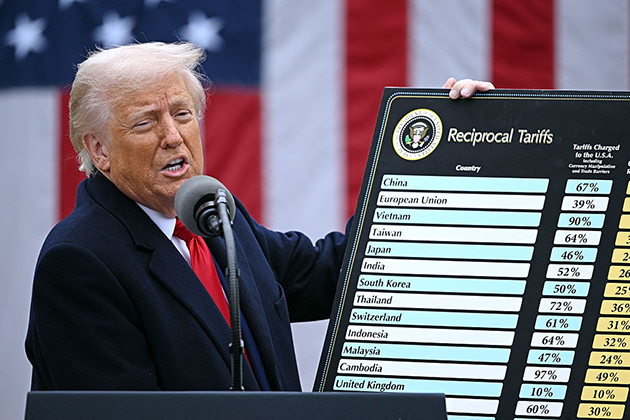
Ever since President Trump started talking about tariffs on imported goods in 2025, there have been questions about their legality, and recently, the U.S. Supreme Court ruled that the tariffs President Trump imposed were illegal under the International Emergency Economic Powers Act (IEEPA). After that ruling, it was in the hands of the Court of International Trade (CIT) to determine if, when and how importers and companies would get refunds for tariffs they already paid. Court rulings could lead to tariff refunds totaling up to $166 billion for U.S. businesses.
In Atmus Filtration Inc. v. United States, the CIT ruled that all Customs and Border Protection (CBP) entries are subject to refunds, even those that have completed both the 314-day liquidation cycle (the time it takes CBP to finalize duty, tax and fee collections) and the 180-day protest period that importers have to challenge duties imposed. It also included the reliquidation of entries for which liquidation has become final. Reliquidation would be a form of refund in that the entry’s original liquidation would be revised or reversed to correct any errors in duty collection.
The court’s ruling also offered insight into how businesses should proceed with similar claims. To ensure they receive their potential refunds, companies will need to:
1. File A Petition to Protest
Even with the CIT’s recent ruling, it is unclear if an importer or company must still file a petition to protest with the CBP in order to receive their refund. This petition is essentially a company’s way of saying they disagree with the duties that were collected upon a shipment entering the country and before it could leave to be distributed.
In the most recent order amending the CIT’s initial ruling, Judge Eaton said, “While developments suggest that protest may not be required to secure the refund of the IEEPA tariffs that have been paid…we continue to recommend that importers monitor entries for liquidation and that protests be filed before the expiration of the 180 day protest period to preserve the rights to recovery, until the CIT and CBP provide more clarity on both the law and process for the recovery of duties.”
Filing a protest with CBP can be done first or at the same time as filing with the CIT.
2. File a Case with the Court of International Trade
The CIT in New York City has exclusive jurisdiction in challenges on customs duties. The court typically picks one lead case to hear and rule on and then applies those rules to all other similar cases it receives. In this situation, the court chose Atmus Filtration Inc. v. United States and ultimately ruled that all importers and companies that paid the Trump administration's tariffs to CBP are entitled to a refund.
It is uncertain whether a company can get a refund if they are not on record filing a petition with CBP. Similarly, it is not clear if the CIT can order a refund to parties that have not filed a case. “If the [CIT] can require a refund to non-parties, the issue will be the status of the customs entry," said Robert Shapiro, chair of Thompson Coburn’s international trade and transportation regulatory practice group.
3. Collect the Refund
To comply with the CIT ruling, CBP is working on a new program to streamline the refund process. The program, Consolidated Administration and Process Entries (CAPE), will be rolled out in phases, with the first being the claims portal. As of April 20, phase one of the program is live on the automated commercial environment (ACE) portal. Closely behind are the remaining three phases: mass processing, review/liquidation and refund.
There is no exact time frame for when the remaining phases will be complete or when all refunds will be issued, but barring any compliance issues, CBP has said that it should take 60 to 90 days to receive a refund once a CAPE application is accepted.
Potential Consumer Refund Liability
However long it may take, once a company receives its refund, it may face legal action from consumers who feel they are owed a portion of the refunded tariff fees. Consumers have already sued companies like FedEx, Costco and Nintendo in class action suits, with the list expected to grow as more refunds are issued.
When the Trump administration implemented the tariffs, many companies passed the burden on to consumers, either by raising a product's price or by adding a fee specifically for tariffs. Now, consumer advocates argue that companies should not be able to “double dip," keeping money from both customers and the government. Since they have already been compensated for the tariff by the consumer, they should not get to keep the government-issued refund and be reimbursed twice.
Companies that are interested in filing for a tariff refund should carefully consider their plan for handling customers who purchased the impacted goods.
“Vendors and customers may be in a position to recover a portion of any recovery,” Shapiro said. “Understanding the risks associated with these ‘follow-on’ claims may be important in deciding which actions to take, as a failure to take actions to recover the duties may place the party in a position where it is not recovering duties from the government, but it is obligated to refund some money to its customer or vendor.”
FedEx has said it will return any tariff refunds to customers and shippers who paid them. But according to a recent lawsuit, Costco has made no commitments to return any portion of anticipated tariff refunds to consumers. However, neither company’s response is legally enforceable, so the ultimate resolution of these refunds remains to be seen.
While there is currently no legal obligation for companies to reimburse consumers for tariffs they paid, companies might want to start planning a reimbursement program should that change. One aspect to consider is whether customers would need to provide proof of purchase. For businesses, the ideal form of verification is an explicit line-item surcharge on the original invoice or receipt, according to Maria Pechurina, director of international trade at Peacock Tariff Consulting. For retailers like Costco, verification will likely rely on internal membership purchase history. In cases where tariffs were already embedded in a general price hike, verification is significantly more difficult, Pechurina said.
“If a company commits to a pass-through, or the transfer of a government-issued refund from the company that originally paid the duty to the customer who ultimately bore the cost, refunds can be expected via the original payment method,” she explained. “However, some companies are proposing ‘future value’—lower prices on future goods—a move currently being challenged in court as insufficient.”
With the recent court rulings ordering CBP to refund importers and companies for the tariffs they paid, companies need to figure out their next move in order to actually get refunded. “Overall, there is still too much uncertainty to direct someone to one solution or the other,” Shapiro said. “The best that we can do is recommend that a case is filed at court and that they file protests against liquidated entries.