
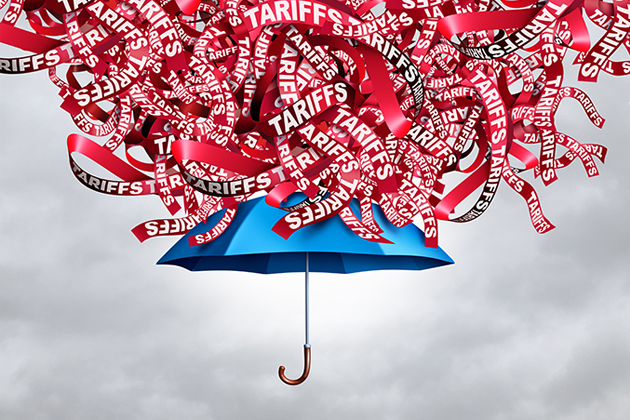
As the Trump administration continues to impose a wide range of tariffs on U.S. imports, U.S.-based companies are facing significant financial uncertainty. Many are paying more to source goods and materials and are experiencing lower profit margins and reduced cash flow, resulting in payment delays or defaults and causing potential accounts receivable problems for global trade partners. Some businesses could face financial distress and, in severe cases, may even be at risk of bankruptcy.
Surging tariff rates and the turbulence of new tariffs being announced or revised at frequent, irregular intervals has magnified the critical role of trade credit insurance in safeguarding businesses engaged in international trade. This coverage absorbs losses due to non-payment of commercial debts, however, relatively few companies have purchased this form of protection.
“Given the current tariff situation, trade credit insurance absolutely should be on a risk manager’s radar,” said Jerry Paulson, senior vice president in HUB International’s complex risk practice. “If a company has to pay 15% to 20% more for raw materials [because of a tariff], the financial impact can be severe. Trade credit insurance helps solve this dilemma by covering the risk of unpaid invoices caused by a customer’s insolvency, mitigating the risk of buyer defaults while freeing up capital and improving cash flow.”
Approximately 15% of global trade is covered by trade credit insurance, according to the International Credit Insurance and Surety Association. Although a March 2025 survey by insurance broker WTW suggested increasing customer demand, most companies engaged in global trade choose not to buy the coverage, either due to perceptions of high cost or restrictive coverage terms, conditions and exclusions. However, brokers note the current geopolitical climate and growing uncertainty over U.S. tariffs and trade disputes may prompt businesses to rethink the value of this insurance line.
“Most global trade is done on open account terms, where goods are shipped and delivered before payment is due,” said Ian Watts, credit risk specialty growth leader at WTW. “Companies cannot manage that risk [of non-payment] without trade credit insurance.”
Aside from reducing the risk of non-payment, trade credit coverage increases the confidence of importers to do business with companies they may otherwise have spurned or neglected in the past. As the exporters’ sales volume increases, cash is freed up to invest into their business for innovation and growth.
“One cannot dismiss the importance of the insurance as a risk mitigant, regardless of the size of the company and whether you are a manufacturer or a wholesaler,” said Marc Wagman, managing director of credit and political risk at Gallagher. “Typically, receivables—the lifeblood of a company fueling cash flow—are the largest uninsured asset on the balance sheet. Having the insurance greases the wheels of global trade.”
Hard Times and Hard Lessons
It is difficult to estimate the number of insurance carriers offering trade credit policies globally, with some reports suggesting around two dozen insurers and government entities, while others peg the total significantly higher. Regardless of the number of providers, it is clear the aggregate size of the market is substantial. The trade credit market is on target to reach $13.3 billion this year, up from $12.2 billion in 2024, demonstrating a compound annual growth rate of 8.9%, according to the Business Research Company.
For years, the trade credit insurance market was relatively stable. When the COVID-19 pandemic began to emerge at the end of 2019, the market suddenly hardened. Many governments mandated lockdowns and closed borders, disrupting global supply chains and trade flows. The volume of trade credit claims shot up significantly. Insurer Euler Hermes (now Allianz Trade) reported huge increases in claims throughout April, May and June 2020. In response, some insurers withdrew their capacity and others decreased their credit limits and became more cautious in their underwriting.
“I was a commercial underwriter at trade credit insurer Coface when COVID hit,” said Sam Rodda, now a client manager of trade credit insurance and political risk at insurance broker Lockton Australia. “The primary markets hardened and increased rates 20% to 30% and the excess [market rates] doubled. Some coverages were cut back 20%.”
Governments intervened to alleviate the negative market consequences. Wanting to support businesses and ensure trade credit insurance coverage and credit limits were maintained during the coronavirus pandemic, the United Kingdom established a temporary £10 billion ($13.1 billion) trade credit reinsurance scheme. The government acted as a reinsurer to private trade credit insurers, sharing the risk of losses. “If the trade credit market pulled back their appetite, it could strain supply chains further, creating a much bigger impact,” said Sarah Murrow, president and CEO of Allianz Trade Americas.
Comparable programs were also implemented in other countries, such as France and Germany, but not in the United States. “As was demonstrated during COVID, trade credit insurance is vital to keeping liquidity in supply chains,” she said. “It is the glue that keeps world trade going.”
Threatening the Status Quo
The latest blow to global trade equilibrium is President Donald Trump’s tariff strategy, characterized by his inclination to issue unpredictable waves high tariffs and seemingly arbitrary deadlines, retreat from these decisions, and then impose even higher tariffs. Although the trade credit insurance market is stable for now, Trump’s vacillating tariff pronouncements could change the status quo. The Trump administration seeks trade reciprocity, an “even playing field” where foreign companies face comparable tariffs when their goods enter U.S. markets that U.S. companies confront when their goods enter foreign markets.
For example, in February, President Trump issued a 10% percent tariff on Chinese imports, increased it to 20% a few weeks later, and then raised it to 145% in April. The next month, he reduced the effective tariff rate to 30%. Then in October, he threatened an additional 100% tariff on Chinese goods that would go into effect on November 1. The president has made similar on-again, off-again tariff declarations to nearly all U.S. trading partners, including a recent 10% tariff increase imposed on Canadian exports after a dispute over an anti-tariff political ad from the government of Ontario.
“This is a very mercurial administration,” Wagman said. “A lot of it is posturing with our trading partners. [Trump] takes astonishingly unreasonable first positions to get trading partners’ attention.”
Assuming high tariffs remain in place for the foreseeable future, an unfavorable impact on trade credit insurance is likely. In a July survey by KPMG, 57% of U.S. companies reported declining gross margins as a direct result of having to pay more for foreign goods. Nearly half the respondents said it is taking them from seven months to a year to implement supply chain changes that are needed to offset high tariffs. “Businesses are navigating a trade environment that’s no longer defined by short-term volatility but by sustained disruption,” Joe Lackner, industrial manufacturing advisory partner at KPMG US, said in a press release.
Several economists also predict that tariffs will increase pressure on companies experiencing financial strains, leading to higher rates of insolvencies down the line. U.S. bankruptcies through March 2025 were at their highest level since 2010, according to data compiled by S&P Global Market Intelligence. Experts are monitoring the evolving insolvency picture closely.
“In certain sectors, we are coming to a point where [customer] vulnerability is increasing, causing insurers to start to reduce cover,” Watts said. “Anything in the external economic environment creating additional risk for companies—tariffs, high interest rates, geopolitical tensions—will be plugged into the algorithms and risk assessments. For longer-term risks, there is a possibility that capacity may be reduced and prices will rise.”
A Stable Market for Now
Despite ongoing tariff uncertainty, the trade credit insurance market remains stable, which is good news for companies buying and selling goods around the world. Insurance brokers and carriers report that prices remain competitive. Capacity is at a near-high point, with multiple carriers offering coverage in addition to the three largest providers: Allianz Trade, Coface SA, and Altradius, which together hold approximately 70% of global risk capacity. “Globally and in the United States, we have a prolonged soft market for trade credit insurance,” Murrow said.
She attributed the present market to the low claims environment that followed the hardened conditions during the COVID-19 pandemic, a period of sharply reduced capacity, tighter underwriting and higher pricing. Credit insurers have since been able to build up their reserves and be more competitive in their risk appetite, she explained.
Even for exporters in countries confronting high U.S. tariffs, the soft market has persisted. For example, President Trump imposed a 35% tariff on goods from Canada starting August 1. Yet, according to Michelle Davy, president of insurance broker CrediAssur and past board chair of the Receivables Association of Canada, "it remains pretty competitive out there, with trade credit insurers still fighting for deals and few insurers exiting the market.”
So far, this has been the case in the United States as well, according to U.S.-based insurance brokers. “Pricing is holding firm, unlike talks of double-digit year-over-year declines in terms of what property/casualty underwriters are quoting—that is not happening in our market,” said Wagman. “To write risk on both a portfolio and single situation basis, the capacity is definitely there.”
However, the lingering impact on suppliers in countries facing steep tariff increases could quickly alter market capital and appetite as companies may seek to replace those suppliers with suppliers in countries facing lower or no U.S. levies. Such a replacement strategy would result in lost income affecting the original supplier’s financial condition, particularly if the U.S. buyer contributed a substantial part of the company’s revenue and profits. The pressure on the supplier’s bottom line could result in payment defaults, generating trade credit losses for insurers. Extrapolated across innumerable global suppliers, the soft market conditions may harden.
“The trade credit market should expect to see more losses overall than normal,” said Julie Potter, senior vice president and head of insurance and small business partnerships at trade credit insurance provider Export Development Canada (EDC). “For us, our loss ratio is increasing.” High U.S. tariffs on Canadian exporters have also compelled some insureds to pause their decision to purchase coverage while they monitor the situation. “The way I look at it, we will likely have more losses,” she said. “When something changes in the system, that is to be expected.”
However, Potter is optimistic that the impact would be short-lived. “In general, as we have seen before, companies are usually able to get through the valleys,” she said. “They are quite agile. We had the financial crisis and the pandemic and got through them, and we will get through this, as long as [trade credit insurance] markets do not lose their risk appetite.”
For the time being, buyers of trade credit insurance still have the upper hand, and should be able to negotiate comparable if not better trade credit terms and prices than at their last policy renewal. “Despite the doom and gloom, it is a good time to buy credit insurance,” Murrow said. “Even though tariffs are at their highest levels since 1940, trade deals are still being made.”
She pointed out that many companies are rerouting their supply chains to suppliers in countries with lower tariffs. “The [trade credit insurance] markets are very much in a wait and see moment to see what shakes out. It continues to be a work in progress,” she said.
As a result, this may be an advantageous time for risk professionals to explore coverage options. “This is a great opportunity for risk managers to present the value of trade credit insurance to their CFO or treasurer to absorb accounts receivable risks while there is still plenty of insurance market capacity, strong carrier appetite and aggressive pricing,” Paulson said. “For those who do not already have a seat at the executive table, this is the invitation.”