

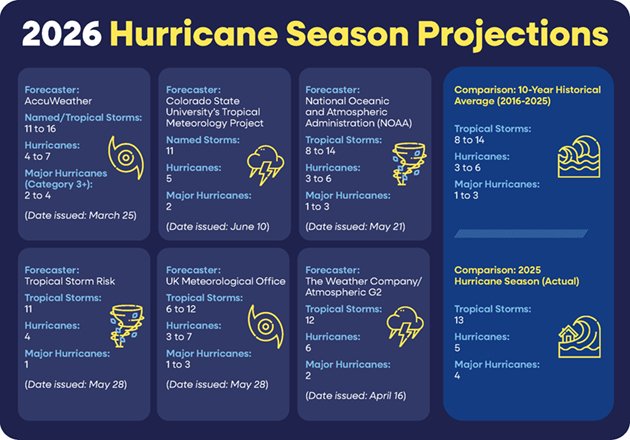
While initial forecasts point to a below-average hurricane season in the Atlantic, risk professionals cannot afford to confuse a lower number of storms with reduced vulnerability. The National Oceanic and Atmospheric Administration (NOAA) projects a 55% chance of a below-average 2026 Atlantic hurricane season, estimating eight to 14 named storms, three to six hurricanes, and one to three major systems. Researchers at Colorado State University (CSU) have echoed this tempered outlook, pegging the probability of a major U.S. landfall at 24%—well below the 43% historical average—with regional landfall risks of 11% for the East Coast, 14% for the Gulf Coast and 26% across the Caribbean. AccuWeather’s meteorology team pointed to the northern and northeastern Gulf Coast and the Carolinas as the areas of the United States at greatest risk of direct impacts from a tropical storm.
Regardless of the forecast, the challenges of hurricane response are compounded by a turbulent operating environment this year. Macro-economic volatility, geopolitical instability and U.S. federal budget cuts have created an exceptionally fragile and challenging recovery landscape. As organizations compete for increasingly expensive materials, absorb the costs of widespread inflation and navigate a stretched federal support system, the margin of error for effective preparation has narrowed. Risk professionals must look beyond forecast headlines to evaluate how their resilience strategies will hold up in an environment where the cost of a single landfall may be higher than ever.
The Impact of El Niño and Other Meteorological Factors
The primary driver behind the subdued projections for the 2026 Atlantic hurricane season is a shifting El Niño Southern Oscillation (ENSO) pattern. According to CSU researchers, a transition toward a moderate to strong El Niño is very likely to fully develop by the season’s peak around September. Under typical El Niño conditions, warmer equatorial Pacific waters generate stronger vertical wind shear across the Atlantic basin. These upper-level winds effectively act as a structural inhibitor for Atlantic hurricanes, breaking up developing systems before they can organize into significant cyclones.
However, El Niño’s storm-suppressing influence faces a powerful counterweight: above-average sea surface temperatures across key portions of the Atlantic. This elevated ocean heat content provides the essential thermal energy required for storm intensification, potentially overriding the mitigating effects of El Niño-induced wind shear.
On June 11, NOAA confirmed that El Niño has officially arrived and will develop into a moderate to strong level by the fall, with a 63% of becoming a “Super El Niño” marked by extremely warm Pacific waters. “The sea surface temperatures are quickly rising in the equatorial Pacific, the region that is measured for El Niño. The latest weekly numbers are averaging out just over 0.5 degrees Celsius, compared to the long-term historic average, which is the primary criteria for El Niño,” explained AccuWeather expert meteorologist Paul Pastelok. “Most El Niños and La Niñas begin in the fall. This El Niño will most likely begin soon and strengthen quickly.”
AccuWeather also noted some increased risk conditions posed by this year’s El Niño. Record high temperatures in the Pacific could fuel more storm cells in the area and lead to increased risk of heavy rain for the West Coast. It could also exacerbate drier conditions in some regions already experiencing severe drought. Further, the firm warned that “homegrown hurricanes” that form close to the U.S. coastline during El Niño years pose heightened risk because they leave little time for preparation.
High ocean heat content also increases the probability that the storms that do form may undergo rapid intensification. This was a key theme in both the 2024 and 2025 hurricane seasons. While last year was relatively “quiet” in terms of storm count, four out of five hurricanes strengthened into major storms of Category 3 or higher, a rate far above historical norms. For risk professionals, the critical takeaway from these meteorological factors is that lower frequency does not equate to lower risk.
Unique Considerations for the 2026 Hurricane Season
This year, a volatile operating environment complicates some of the biggest challenges of hurricane response. Widespread inflation, oil price hikes, a significantly disrupted supply chain and surging costs paired with reduced availability are already impacting many businesses, and natural disasters may amplify these issues at times organizations—and their people—may be most vulnerable. Federal budget cuts and dysfunction add uncertainty about relief and response safeguards. Risk professionals should consider the following unique issues that may be key factors in preparing for hurricane season and other natural disasters this year.
Eastern Pacific Hurricanes: Learning from Another Hilary
Eastern Pacific hurricane season began May 15, two weeks before the June 1 start in the Atlantic because waters in the region typically warm earlier. Atlantic hurricane season usually gets most of the attention in the United States because it tends to be more active and it poses a greater threat to populated islands and the U.S. coastline. However, there is notably increased risk in the Pacific this year that has escalated quickly. The emerging El Niño pattern is characterized by warmer equatorial waters in the Eastern Pacific, and the warm, wet conditions and reduced vertical wind shear can lead to a more active season there. This can have implications for Mexico, the U.S. West Coast and Hawaii. By June 8, three named storms had already formed in the region—Amanda, Boris and Cristina. Boris made landfall in western Mexico on June 8 as a tropical storm.
Hurricane Hilary was a rare Pacific storm to hit the Southwestern U.S. in 2023—also a strong El Niño season. After undergoing rapid intensification and peaking as a Category 4 storm, Hilary struck Baja California and then moved into California and the Southwestern United States as a tropical storm. It directly led to three deaths in Mexico and California and ultimately caused more than $900 million in damage in the United States, according to NOAA estimates. Hilarys do not do things by half-measures, and risk professionals should not either—do not dismiss the risk of Pacific hurricane activity.
Impacts of the War in Iran
While domestic inflation continues to strain corporate balance sheets, risk professionals preparing for the 2026 hurricane season must also account for a geopolitical crisis thousands of miles away. The war in Iran and the subsequent closure of the Strait of Hormuz have disrupted international shipping traffic, stalled maritime freight and triggered sharp increases in global energy prices. With the Strait of Hormuz closed, container ships must be rerouted around Africa, adding about two weeks to international transit times, driving up freight costs and decreasing supply availability. For organizations attempting to mitigate storm damage or navigate post-landfall recovery, these seemingly distant pressures could transform routine preparation and repair into complex financial and operational challenges.
The impact on an organization’s disaster budget is already becoming evident. Since the closure of the Strait of Hormuz in February 2026, crude oil has persistently remained near $100 per barrel. According to data from the Associated General Contractors of America (AGC) and the Bureau of Labor Statistics (BLS), this energy shock is driving up the cost of many physical materials required to protect facilities. Because manufacturers are passing these fuel and raw material costs down the supply chain, disaster mitigation and repair budgets will not yield the protection they have in years past.
This price volatility directly compromises response logistics, baseline barrier material supply and facility preparedness. Specific material price spikes include:
- Generator fuel: Surging crude prices have driven fuel costs to historic highs, dramatically inflating the costs of running backup generators and the 72-hour diesel reserve often considered a best practice.
- Structural barrier materials: Plywood and structural lumber—the baseline defense materials for window protection—are subject to increased domestic transport costs on top of already inflated prices due to tariffs. Further, because plywood production relies heavily on petroleum-based resins and adhesives, its baseline pricing is highly vulnerable to oil market spikes.
- Plastics and seals: Heavy-duty plastic sheeting and polymer tarps are direct petroleum derivatives, so their production costs follow crude oil surges almost immediately. Similarly, manufactured rubber seals, membranes and weatherstripping used to waterproof critical facility entry points are becoming more expensive due to rising petrochemical processing costs.
These compounding factors introduce significant indirect operational risks. With fuel and material prices experiencing such dramatic volatility, contractors may find it difficult to fulfill emergency repair agreements under older, fixed-price contracts. Further, critical components for backup power systems and facility repairs face extensive backlogs due to maritime shipping bottlenecks, potentially stalling recovery efforts. According to supply chain analysts, even if the Strait of Hormuz opened tomorrow, supply chain disruptions and material price inflation would be likely to persist for a minimum of six months, making last-minute, just-in-time disaster procurement both financially and logistically prohibitive.
Under-Insurance for Inflated Replacement Costs
In the construction industry, inflation and Iran war-related price hikes are driving up transportation and production costs and delaying delivery of critical materials. Many essential materials are more vulnerable to delays or price hikes because they are produced or sourced in the Middle East, including cement, steel, concrete and aluminum. Local labor surge and delay costs on top of inflated costs add up to potential significant gaps between repair and replacement costs and previous value calculations for insured property. Uncertain supply, prolonged repair times and labor shortages amid post-disaster demand will also likely contribute to greater business interruption risks for organizations impacted by storm damage.
Risk professionals should reach out to their broker or insurer to make sure their organization’s insurance policies are sufficient to cover costs of repairing or rebuilding property, replacing its contents, and aiding in whatever temporary arrangements may be needed if the premises are not safe for occupants in the aftermath of a storm. It is also a good time to check limits for flooding and wind damage, specifically, to ensure the organization has adequate limits for tropical storm losses as well as other extreme weather.
Organizations that have fleets should also assess coverage for vehicles. Costs have surged dramatically for metals, plastics and rubber as a result of the war, with increases in production costs as well as shipping and logistics challenges. These materials were already seeing notable price increases under the Trump administration’s tariffs, and its war is making both cost and availability acute problems.
Federal Government Changes Compromise Emergency Response
While inflation and geopolitics strain commercial supply chains, risk professionals also face growing questions about the availability of federal resources to stabilize public infrastructure after a major catastrophe. Driven by recent organizational restructuring, staffing reductions and-structural budget adjustments, there is significant uncertainty about capacity and functionality of the Federal Emergency Management Agency (FEMA) going into the 2026 hurricane season.
In a formal letter to DHS Secretary Markwayne Mullin and Robert Fenton, Jr., acting administrator of FEMA, members of the House Committee on Homeland Security expressed serious concerns about the agency’s baseline readiness for the 2026 hurricane season. Citing an estimated 14% workforce reduction and 50% vacancy rate in top leadership roles, the letter warned of “deteriorating readiness to protect the American people,” asserting that FEMA is “less prepared to respond than it has been in a generation.” Several proactive pre-disaster mitigation initiatives have also been cut, including the Building Resilient Infrastructure and Communities (BRIC) program and standard Flood Mitigation Assistance grants, leaving many communities at greater baseline risk.
Beyond personnel shortages, recent structural policy overhauls have introduced aggressive compliance frameworks that threaten to delay the deployment of emergency funding. By slashing the DHS threshold for individual disaster and contract payments that require secretarial approval from $25 million down to just $100,000, leadership created an unprecedented administrative bottleneck. Paired with a 76-day DHS funding shutdown in early 2026, these restrictive oversight protocols forced FEMA to trigger its Immediate Needs Funding (INF) protocol. Under INF restrictions, non-urgent public assistance claims, including municipal infrastructure reimbursements and long-term public works rebuilding projects, are routinely paused or denied if they are not immediate life-safety operations.
For organizations mapping out post-disaster recovery, hamstrung federal partners pose significant business continuity risks and may require rethinking core assumptions of disaster response plans. Traditional disaster response models often assume the rapid restoration of public grids, regional water treatment systems and municipal transit routes. However, if local utilities cannot secure timely federal assistance to rebuild, the resulting downtime can directly impact the private sector. As federal policy increasingly shifts the financial and logistical burdens of long-term recovery onto state, local and private entities, corporate self-reliance may be evolving from a strategic best practice to an operational necessity.
Personal Risks and Workforce Disruption
An organization’s workforce is the backbone of resilience. Severe personal and professional disruption should be core concerns for risk professionals when going into disaster season. When a catastrophic storm strikes, employees must navigate sudden personal crises, including property damage and family displacement, while simultaneously attempting to minimize business interruption and restore operations to pre-disaster productivity. This year, widespread inflation and supply shortages compound the challenges for employees too. Rising costs for temporary housing, fuel and emergency supplies place unprecedented financial strain on displaced personnel or those preparing for storms. For risk professionals, failing to account for this economic pressure can cause even sophisticated technical recovery plans to quickly fall apart in execution.
Incorporating employee-centric continuity strategies into disaster preparedness can help mitigate this risk. Organizations looking to be proactive in caring for their people could consider ways to support employees facing hurricane threats, such as helping to source bulk emergency supplies, providing pre-assembled disaster preparation kits, and offering paid time for preparation when a hurricane is approaching.