
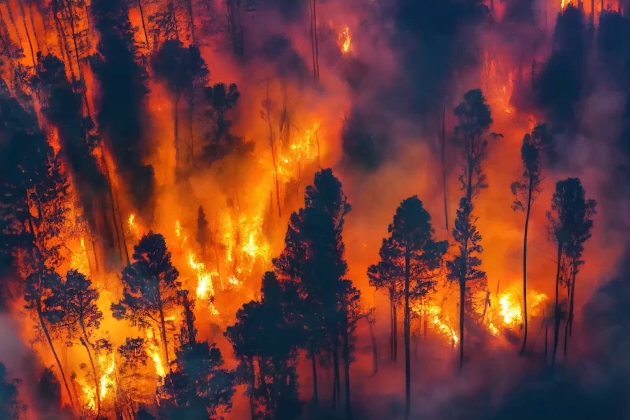
Record high temperatures, historically low winter snowpack and persistent drought have created the optimal conditions for a particularly brutal wildfire season in 2026. As of September 16, the National Interagency Fire Center (NIFC) reported that firefighters have responded to 56,042 wildfires that have burned more than 8.5 million acres across the United States. According to NIFC data, this is the highest number of fires in over a decade, far exceeding the 10-year average for both total fires and acres burned. By contrast, on the same date last year, 49,806 wildfires had burned 4.3 million acres.
Notably, while major blazes have damaged traditionally high-risk areas like parts of California and the Southwest, the Pacific Northwest has also been a major fire center and elevated fire activity has impacted communities across non-traditional regions like the Southern Plains and Southeast. The sheer number and scale of the fires have posed significant challenges for firefighters and other first responders, and many of the season’s fires have proven particularly dangerous. By mid-August, federal data indicated firefighter entrapments—life-threatening situations in which fire conditions cut off escape routes and compromise safety zones of firefighters—hit a 20-year high, suggesting fires have become more volatile and are putting greater constraints on operating conditions.
Globally, Swiss Re reports that wildfire has become the fastest-growing weather peril, with an increase in abnormally aggressive wildfire activity in areas not traditionally considered high-risk. While insured natural catastrophe losses were down overall in the first half of 2026, Swiss Re Institute reported June’s record heat and persistent dry conditions set the stage for an unusually aggressive wildfire season across Europe, where major fires ravaged parts of France, Spain and Greece, straining local resources and shattering historical benchmarks.
In France, more than 284,171 acres (115,000 hectares) have burned this year—nearly double the 2022 total. The rapidly spreading fires prompted French President Emmanuel Macron to declare the outbreak the country’s most challenging emergency since World War II. Over 250,000 residents and tourists had to be evacuated from the regions of Landes and Gironde, where Bordeaux is located, at the height of the tourism season and amid record heatwaves. At the same time, the 77,000-hectare Burgohondo fire complex became the largest single wildfire in Spain’s modern history, leading the nation to declare emergencies in four provinces and severely disrupting operations in the local agriculture, wine-making and tourism sectors. As of August 27, 729,962 acres (295,405 hectares) had burned in Spain—46.7% of the total area burned across the European Union this year. Greece, Portugal, Italy and Croatia have also been fighting significant fire activity.
Canada has also suffered what Prime Minister Mark Carney called one of the nation’s most intense wildfire seasons on record. By late July, Canada had already surpassed its 10-year average with about 7.3 million acres (2.95 million hectares) burned. In just one week in July, intense heat paired with more than 34,000 heat-induced lightning strikes to spark over 90 wildfires, resulting in 25 separate evacuation orders in British Columbia alone. Fire activity rapidly surged late in the summer, ultimately reaching a cumulative burned area of 11 million acres (4.4 million hectares) by September 16, according to the Canadian Interagency Forest Fire Centre.
Canada is home to 10% of the world’s total forest area and 24% of the world’s boreal forests. As wildfires are part of a forest’s natural cycle, there is always a baseline level of activity in the region. However, this year’s fires have been remarkable in both scale and level of disruption. Many First Nations communities have been forced to evacuate and have incurred damage, and fires in Ontario and British Columbia have impacted major metro areas. Wildfire smoke also repeatedly presented a crisis of its own, causing hazardous air quality across wide swathes of both Canada and the United States, turning even remote fires into international public health, workforce, transportation and business continuity risks.
A Changing Risk Profile
Last year, wildfires made up 45% of insured natural catastrophe losses as the United States experienced unprecedented wildfire losses of over $40 billion, largely driven by devastating fires on high-value and high-density property in and around Los Angeles. While that single event was an anomaly, wildfires have comprised a rapidly growing proportion of annual insured losses over the past decade. According to a recent Swiss Re Institute sigma report, wildfires made up 9% of annual insured losses from 2015 to 2024, compared to 1% from 2005 to 2014.
Zooming out further, the report noted insured wildfire losses in North America have grown twice as fast as exposure over the past 55 years. Exposure-related factors like construction cost and population at risk only explain one-third of wildfire loss growth. The remaining two-thirds reflect changes in the underlying risk landscape, “driven by the increase of high-value assets in high-risk regions, changes in weather conditions (drought and strong winds) and sources of fuel (flammable structures linked by dry grassland that provide a pathway for fire),” according to Swiss Re.
For 2026, El Niño is increasing the risk of severe fires as the climate pattern typically leads to higher heat and drier conditions. This year’s El Niño is likely to be the strongest on record, according to a September 16 report from AccuWeather, which also noted 2026 is currently the second-hottest year on record and may take the top spot by year-end. Warmer temperatures often mean a longer wildfire season and a greater incidence of heat-related lightning. While an estimated 85% of wildfires are started by humans, lightning is their most frequent natural cause.
“One useful way to think about the changing wildfire risk landscape is that climate change is altering the background conditions under which fires occur,” AccuWeather Chief Meteorologist Jonathan Porter told Risk Management. “High heat and lower humidity associated with periods of decreased precipitation and drought can dry out vegetation and the fuels fires use to burn.”
Climate and weather trends are significantly impacting every dimension of wildfires: lengthening their season—potentially to the point of eliminating a discrete season altogether; increasing the frequency, severity and duration of fires; and redrawing borders of at-risk regions.
The Evolving Geography of Wildfire Risk
Wildfire risk maps are being progressively redrawn, spreading into new regions due to increases in both natural and man-made risks. The most readily apparent are complications from climate change and severe weather. “Weather remains a critical short-term driver for wildfire risk,” Porter said. “High winds, low humidity and, in many cases, extreme heat can rapidly increase fire spread and intensity. The result is not simply that every location is becoming more likely to burn, but that in many regions, the conditions that support large and severe fires are becoming more frequent.”
In areas historically considered at high risk for wildfires, heat and drought are creating conditions exponentially more conducive to severe and frequent fires. Perhaps even more concerning, heat is also increasing the vulnerability of regions and ecosystems considered less fire-prone. In traditionally hot areas, like the American Southwest, trees and other vegetation have adapted to heat, drought and fire—they certainly still burn, but evolution has helped mitigate some of the risk in native vegetation. Areas that are historically cooler and wetter, such as California’s Sierra Nevada mountains and Canada’s boreal forests, have not undergone the same adaptations. Now, extended periods of heat and dryness are leading to a loss of moisture in trees, making these ecosystems progressively more combustible.
On a seasonal level, local weather and vegetation growth patterns have further increased vulnerability by creating abundant tinder, resulting in some of this year’s most notable wildfires. In Western and Southern Europe, for example, a relatively wet winter led to prolific vegetation, then heatwaves baked all that new growth into what is essentially kindling. This effectively turned many areas in tinder boxes just waiting for a spark. This pattern is increasingly being seen worldwide as a result of climate change and is a major factor in the growing footprint of wildfire risk.
With increased development in and around wildlife-urban interface (WUI) zones, the risk is also growing in terms of both property at risk and the means of ignition. “In relative terms, population growth since 1975 in high wildfire-risk areas of the United States has been three times higher than overall across the country,” according to the Swiss Re Institute’s sigma report. “With population growth comes exposure growth, that is accumulation of property and other assets that need insuring. Since 1990, exposure growth in WUI zones has outpaced that in non-WUI zones by a factor of 1.8 in the United States, and by a factor of 1.9 in California.” This has led to fires becoming more likely, more destructive, more dangerous and more expensive. As of 2020, the report noted, one in three Californians now resides in the WUI, and the devastating fires in 2025 burned exclusively in the WUI in Los Angeles, leading to mass evacuations and over $40 billion in damages—a figure that would have been otherwise unthinkable.
Population expansion in the WUI also increases the risk of wildfires being started. “Humans cause about 85% of U.S. wildfire ignitions, creating a self-reinforcing feedback loop,” the report noted. “As populations in the WUI increase, both the exposure and the hazard (ignition risk) are higher. This human-based component poses challenges for traditional catastrophe modeling on account of the complex interactions between hazard and exposure.”
“Wildfires have become one of the defining natural hazards shaping North America’s risk landscape,” said Jolee Crosby, CEO of Swiss Re Canada. “While changing weather conditions are one part of the picture, growing exposure in wildfire-prone areas is equally important.”
Smoke Becomes More Than a Secondary Peril
The geography of wildfire risk is also dramatically expanding due to the added effects of the growing number, size and duration of fires, paired with other climate patterns. “There is an important distinction between the geographic footprint of a fire and the geographic footprint of its impacts,” Porter said. “Smoke can be transported hundreds or even thousands of miles depending on plume height and the atmospheric winds, meaning businesses well outside the immediate vicinity of a fire can experience poor air quality, risking health and safety.”
Amid Canada’s wildfires this summer, for example, large portions of Canada and the United States experienced significant smoke pollution and dangerous air conditions. Smoke plumes carrying high concentrations of fine particulate matter were caught in upper-level atmospheric currents and transported thousands of miles from burning forests. As a result, a thick and hazardous haze blanketed parts of Canada, the U.S. Midwest and the East Coast, triggering severe air quality alerts for more than 100 million people, prompting authorities to advise people to stay indoors, disrupting regional aviation and halting outdoor commercial operations.
Under such conditions, even a few hours outside can expose people to surprising amounts of harmful fine-particle pollution. “AccuWeather estimates that breathing the polluted air in the worst impacted areas of the Northeast for several hours can result in breathing in the same level of harmful air as smoking five to 10 cigarettes,” according to Porter.
For risk professionals, the smoke emergencies offer one of the key takeaways from the 2026 season: Physical proximity to a burn zone is not a prerequisite for business interruption, physical peril and material financial loss. The compounding effects of prolonged heatwaves, regional utility shutoffs, supply chain bottlenecks and far-reaching smoke plumes mean that wildfires are increasingly a borderless hazard with enterprise-wide operational implications. Organizations that continue to view wildfire solely as a localized, property-specific peril face major gaps in both their operational continuity and risk transfer strategies.
Risk (Re)Assessment
As wildfire risk is evolving, risk professionals everywhere should reassess their organization’s exposure to wildfires and various knock-on effects. Given the expanding geographic profile of fire risk and widespread smoke emergencies, a far greater number of organizations are at risk than have historically considered wildfires a relevant concern. As a result, it is critical to reassess the risk regardless of location or nature of the business.
“Businesses need to consider wildfire risk not only as a direct physical hazard, but also as a broader business interruption, operational and health and safety risk,” Porter said. These risks include smoke exposure, employee health, transportation disruptions, power outages, and impacts on suppliers or customers. Assessing wildfire exposure requires looking beyond proximity to burnable vegetation and considering the broader ways a wildfire could affect a business, including fires near or distant from operating locations and key points in the supply chain.”
Risk professionals should examine their direct exposure as well as the potential impact of smoke on operations. For example, construction companies on the East Coast have had to contend with unsafe working conditions on jobsites. Risk professionals must reconsider their risk profile in light of such wider zones of potential impact and reassess how to allocate time and money on mitigation efforts and safety processes, as well as the potential cost of reduced or disrupted work on impacted sites. Looking back at the 2026 season, organizations may want to consider such smoke emergencies and develop response plans or procedures to address the unique challenges hazardous smoke events can present. This might include installing filtration systems for indoor office spaces, providing masks or other equipment for outdoor workers, and developing formal policies on what operational changes to make at different levels of air quality.
Recalibrating Insurance Coverage
Much as with severe convective storms, wildfire trends demonstrate that so-called secondary perils have now become primary drivers of loss. Those facing new levels of exposure to wildfire and associated risks should be reviewing existing policies for coverage and discussing with their broker or insurer about expanding their insurance program to explicitly cover wildfire risks.
Given the increasing risks and mounting losses in recent years, insurers are clearly reassessing their own risk exposure as well. As coverage becomes more expensive or even unavailable, many buyers are looking to other options for risk transfer. Whether through catastrophe bonds, parametric policies, captives or structured pools, the alternative risk transfer market has stepped up for a range of buyers seeking different coverage options. Last year alone, insurers issued $5.55 billion of cat bonds with some level of exposure to wildfire risk, according to data from alternative risk transfer news service Artemis. That was more than twice the issuance in 2024, and risk capital deployment had already surged past $5.18 billion in August 2026.
Some highly-exposed entities are looking to insurance-linked securities (ILS) and other alternative risk transfer (ART) options to insure against wildfire risks that are increasingly uninsurable through traditional policies. For example, the largest U.S. municipal utility, the Los Angeles Department of Water and Power (LADWP), has repeatedly secured coverage through the catastrophe bond market since 2020. In June, LADWP turned to the market for its fourth cat bond, seeking up to $100 million in coverage on an industry loss trigger for wildfire-related damage to its infrastructure. ILS and ART options also offer greater control as exposure itself evolves. For example, LADWP’s infrastructure can not only be damaged by fires but can also ignite them, as seen when the Pacific Gas and Electric Company’s downed transmission line sparked the 2018 Camp Fire. PG&E ultimately pled guilty to 84 counts of involuntary manslaughter and one felony count of unlawfully causing a fire, and reached a $13.5 billion settlement to compensate survivors. To address that side of the risk, LADWP’s new bond likely also contains elements of wildfire liability protection, according to Artemis.
On the homeowners’ side, insurers and various state and municipal authorities are imposing additional requirements for property-owners and growing scrutiny about mitigation measures. As losses mount, organizations should consider the potential extension of similar enhanced expectations to business properties. Enterprises in traditional wildfire-prone regions have long had to take such steps, but as the areas at risk continue to evolve, organizations in newly exposed areas may need to play catch-up— and would be wise to do so before it potentially threatens to preclude them from coverage or increases liability exposure.
Moving forward, organizations and public entities alike should also consider longer-term resilience measures and risk-aware land-use decisions in addition to insurance. “As more people and more valuable assets are located in wildfire-prone areas, resilience becomes just as important as recovery,” Crosby said. “Insurance is there to help communities rebuild after disasters, but long-term resilience will depend on continued investment in mitigation, preparedness and smarter development.”